Printer
Mini Unit
Notes Cloze
Printers
Printers
can be (1)___________________ biggest headache in the (2)___________________
environment because when the (3)___________________ goes down…productivity
stops and (4)___________________ freak out.
Knowing
how (5)___________________ printers work will help (6)___________________ be a
more effective (7)___________________*
Types of Printers
Dot
(8)___________________/Impact
Dye
sublimation
Laser
Ink
(9)___________________
Thermal*
Dot-matrix
impact printers
(10)___________________
contain 9 or 24 (11)___________________ and “hit” a ribbon
(12)___________________ pins that are pushed (13)___________________ to make
the shape (14)___________________ letters, numbers, and punctuation.
(15)___________________ noisy!
Daisywheel
printers have (16)___________________ “daisy” array of letters
(17)___________________ to the ends of (18)___________________ bars that turn
and (19)___________________ the ribbon.
Dot
matrix (20)___________________ still used due to (21)___________________
ability to print onto (22)___________________-part forms
A
tractor feed “(23)___________________” the paper through using
(24)___________________ strips on either side (25)___________________ the page
with holes (26)___________________ it.
Can
also use (27)___________________ feed, but this causes (28)___________________
MYRIAD or paper jams.
(29)___________________
very low DPI rating*
(30)___________________
Printers
Inkjet Printers
Aka
“(31)___________________ dispersion” and “bubblejet”
Ink
(32)___________________ forced through tiny nozzles (33)___________________ the
paper
Each
nozzle (34)___________________ 50-60 microns in diameter
(35)___________________
methods
Thermal
bubble
Heats
(36)___________________ ink, which vaporizes, creating (37)___________________
bubble that splats out (38)___________________ the page.
Pieoelectric
bubble
(39)___________________
a bubble with a (40)___________________ crystal behind each nozzle.
(41)___________________ electric current vibrates, causing (42)___________________
to either release ink (43)___________________ draw ink into the
(44)___________________ (inward vibration releases, outward
(45)___________________ ink in)*
Inkjet
Cartridges
(46)___________________
that hold ink
One
(47)___________________ hold four colors
Four
(48)___________________ cartridges
Colors
are cyan, (49)___________________, magenta, and black
Colors
(50)___________________ together to create millions (51)___________________
colors
Shades
are created (52)___________________ dithering by varying the
(53)___________________ of dots
The
printhead (54)___________________ usually part of the (55)___________________
cartridge, which is why (56)___________________ cartridges don’t work as
(57)___________________ as new.*
Inkjet
Printers
(58)___________________
Quality
There
are usually (59)___________________-600 nozzles on an inkjet
(60)___________________ head, allowing 300 to (61)___________________ dpi
Piezoelectric
printers can (62)___________________ 720x720
Features
Higher
quality
(63)___________________
can print on CDs
(64)___________________
can use photo-ink to (65)___________________ realistic photos on photo
(66)___________________
Paper
sits in a (67)___________________ and is drawn in (68)___________________
rollers
<http://www.microscopy-uk.org.uk/mag/indexmag.html?http://www.microscopy-uk.org.uk/mag/artjan99/inkjet.html>
Inkjet
Issues
(69)___________________
look good, but are (70)___________________ waterproof and won’t last
(71)___________________ long
Pages
printed can (72)___________________
Recycled
cartridges can have (73)___________________ print quality*
Laser
Printers
(74)___________________
are produced using the (75)___________________ process which combines
Electrostatic
(76)___________________
Toner
Laser
light
To
(77)___________________ high quality, waterproof images*
(78)___________________
Printer Components
Toner
cartridge
(79)___________________
scanning assembly
Power
supplies
(80)___________________
control and transport assembly
(81)___________________
corona assembly
Fusing
assembly
(82)___________________
control package
Installed
and (83)___________________ RAM*
Toner
Cartridges
Hopper
(84)___________________ with toner—a fine powder (85)___________________ of
plastic, iron, and (86)___________________ particles
EP
drum covered (87)___________________ a photosensitive coating that
(88)___________________ a static charge until (89)___________________ to light
A
blade (90)___________________ removes used toner from (91)___________________
drum
A
corona charging (92)___________________ which applies a charge
(93)___________________ the drum after the (94)___________________ has
printed.*
Toner
Cartridge
(95)___________________
Scanning Assembly
Laser—shines
on (96)___________________ drum to create an (97)___________________ image of
what’s being (98)___________________ using areas of negative
(99)___________________ positive charge
Mirror—reflects
the (100)___________________ beam
Lenses—focuses
the laser (101)___________________. Multiple lenses can be
(102)___________________.*
Electrostatic
Printing Process
Laser
(103)___________________ Process
You DO have (104)___________________ remember
the voltages
Cleaning
- (105)___________________ Rubber Blade removes (106)___________________ excess
toner which drops (107)___________________ the debris cavity. The
(108)___________________ lamp that removes any (109)___________________ charge
off the photosensitive (110)___________________. This leaves the drum
(111)___________________ a charge of 0 (112)___________________
Laser
Printing Process
You (113)___________________ have to remember
the (114)___________________
Conditioning
- The primary (115)___________________ (High Voltage Wire) adds
(116)___________________ negative charge of around -(117)___________________
volts to - 1000 (118)___________________
Writing
- The laser (119)___________________ hits the photosensitive drum,
(120)___________________ the light hits the (121)___________________ it
dissipates the negative (122)___________________ to the center of
(123)___________________ drum which is grounded. (124)___________________ then
leaves sections of (125)___________________ drum with a voltage
(126)___________________ -100 volts
Laser
Printing (127)___________________
You DO have to (128)___________________ the
voltages
Developing
- (129)___________________ drum rolls through a (130)___________________ of
negatively charged toner (131)___________________ (Particles are -200 Volts
(132)___________________ -500 Volts)
Where
the (133)___________________ hasn't been touched by (134)___________________
laser light a lower (135)___________________ charge is still there,
(136)___________________ the particles are not (137)___________________ to this
section of (138)___________________ photosensitive drum.
Laser
Printing (139)___________________
You DO have to (140)___________________ the
voltages
Transfer
- (141)___________________ strong positive charge is (142)___________________
to the paper, the (143)___________________ of toner are attracted
(144)___________________ the paper.
Fusing
- (145)___________________ toner that is on (146)___________________ paper is
heated and (147)___________________, the toner becomes bonded
(148)___________________ the paper.
To
remember (149)___________________ process
Clean-Charge-Write-Develop-Transfer-Fuse
California-Cows-Won't-Dance-The-Fandango
Can
(150)___________________ Write Down The Facts?
(151)___________________
can guarantee this is (152)___________________ the test.
Other
Printers
(153)___________________
Ink—use a stick of (154)___________________ that is melted to
(155)___________________ ink, then sprayed onto (156)___________________ drum.
Paper passes over (157)___________________ drum and under a
(158)___________________ to transfer the image. (159)___________________ high
quality, non-toxic, and (160)___________________ friendly
Dye
sublimation—dye is (161)___________________ contained on a ribbon
(162)___________________ roll. Print head is (163)___________________ against
the paper using (164)___________________. Color depth is controlled
(165)___________________ the amount of heat (166)___________________. They
require special paper. (167)___________________ the dye is applied,
(168)___________________ layer is applied to (169)___________________ the image
from water, (170)___________________, and fingerprints.
Other
Printers
(171)___________________
Printers—Output is produced with (172)___________________ using either
Thermal
wax (173)___________________—Use ink with a wax (174)___________________. A
heating element in (175)___________________ printhead melts the ink
(176)___________________ the ribbon. Creates a (177)___________________ image
Direct
thermal transfer—Use (178)___________________ paper and a row (179)___________________
heating elements burns dots (180)___________________ on the paper. Monochrome.
(181)___________________
autochrome—Uses special paper with (182)___________________ pigments embedded.
Each page (183)___________________ 3 times under the (184)___________________
at different temperatures that (185)___________________ out the colors. UV
(186)___________________ sets the colors.
Other
(187)___________________
Plotters—pen
based devices that (188)___________________ line images. Mostly used
(189)___________________ engineering.
The
Windows Print (190)___________________
Client
User
sends print (191)___________________
Program
calls the GDI ((192)___________________ Device Interface)
Spooler
receives (193)___________________ job from the GDI
(194)___________________
Windows Print Process
Spooler
(195)___________________.drv
issues an RPC (remote (196)___________________ call) to Spoolsv.exe (spool
(197)___________________)
Spoolsv.exe
calls the Spoolss.dll ((198)___________________ router)
Localspl.dll
routes the (199)___________________ job to either the (200)___________________
printer or the print (201)___________________
Job
goes either directly (202)___________________ the to the port
(203)___________________ or to a language (204)___________________ THEN to the
port (205)___________________.
Language
monitor translates the (206)___________________ into code the printer
(207)___________________ understand
The
Windows Print (208)___________________
Printer
Spooler
sends the (209)___________________ to the Printer (not (210)___________________
hardware device, but the (211)___________________ or driver)
Print
language (212)___________________ translated.
Print
device prints.
(213)___________________
a laser printer, the (214)___________________ is stored in the
(215)___________________. Other printers, the RAM (216)___________________ the
server or local (217)___________________ is used.*
Installing
Locally
(218)___________________
device
Install
downloaded or (219)___________________ driver and utilities
Network
(220)___________________
a printer share on (221)___________________ network or locate the
(222)___________________ itself and create a (223)___________________ (see
labs)
Lab Check off
Sheet and Report
Check off each of the labs as you complete
them below. Turn this in with your lab reports.
|
Requirement |
Completed |
Filled Out Lab Sheet |
Not Attempted (0 on labs for
unit) |
|
Lab P-1 Install a local printer |
|
|
|
|
Lab P-2 Install a local printer to share
on a network |
|
|
|
|
Lab P-3 Install a network printer and
share it |
|
|
|
|
Lab P-4 Troubleshooting Scenarios |
|
|
|
Lab
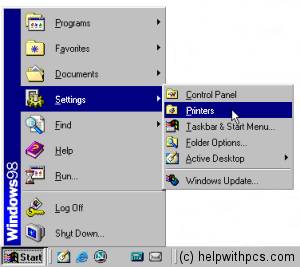
P-1 Installing a Local Printer in Windows 98
- Get a printer from me
and set it up on your lab computer.
- You may need to search
for a cable to connect it. Be sure to return that cable to its proper
place when you are finished.
- Go online on a Dell
and find the drivers for all three of the operating systems you are using.
Plug and Play Printers - Usually to install a
plug and play printer is simply a case of connecting it to your PC (connect
with power off if it is a parallel printer) and following the instructions that
came with your printer, if you have problems read the steps below.
Non Plug and Play - If you have a non plug and play printer or the
machine is not recognizing the printer then you will need to install the
printer manually, to do this follow the instructions below.
The instructions below are GENERAL. Your actual
experience may vary.
|
|
Printer with USB Interface |
|
|
Printer with Parallel Interface |
|
|
If your printer is plug and play compatible then the PC will find the
printer itself, in this case simply follow the on screen instructions. |
|
|
Now double click on the Add Printer icon as shown on the left. |
|
|
You will be presented with a screen telling you to click Next
to continue installing a new printer, click the Next button. |
|
|
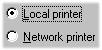
Next it asks you if the printer is a local or network printer, choose Local
(unless your printer is on a network) and then click the Next button. |
|
|
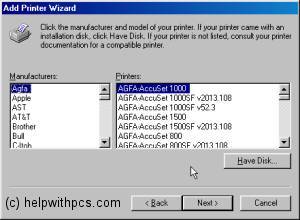
Now you get presented with a window as shown on the left, if you have
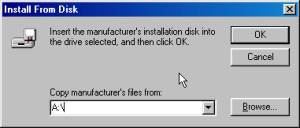
the Disk/CD that came with your printer then click Have Disk if you
don't have a driver disk/CD for your printer then see if the printer is
listed among those printers available. |
|
|
When you have the Disk/CD |
|
|
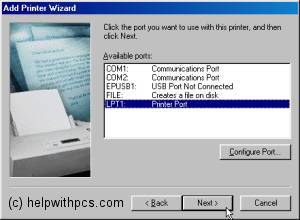
Next you are asked which port you would like to install the printer,
if it is a parallel printer then choose LPT1 (standard), if it is a USB
printer then choose the USB port (although USB printers should install
themselves). When you have selected one of the ports click the Next
button. |
|
|
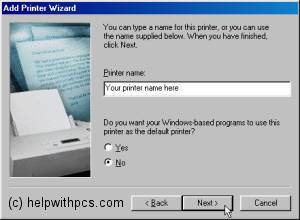
Now you get an option to rename the printer and/or select it as the
default printer for Windows 98 based programs. Unless you have a reason to
change the name then you can leave it as it is, making the printer the
default or not also depends on your choice. |




Prove to me you can
print to get this checked off.
Questions
- What type of printer did you install?
- What is the name of the printer you
installed?
- Where did you find the driver?
- What interface does the printer use?
- Can you share this printer if you’re on
a network?
Lab
P-2 Installing a Printer Share on a Network
- Get a printer from me
and set it up on your DELL computer.
- You may need to search
for a cable to connect it. Be sure to return that cable to its proper
place when you are finished.
- Go online on a Dell
and find the drivers for all three of the operating systems you are using.
- Install the printer.
Now share it.
- Right click on the
printer.
- Select “Sharing”
- Name the printer
share something simple
- Write down the name
of your computer
- Write down the name
of the share
- Prove that the printer
can be accessed from another computer.
a.
Open the run command
b.
Type \\nameofcomputer\nameofshare
i.
Name of computer=your
computer name (you wrote it down in d)
ii.
Name of share=the share
name you gave your printer
- Install additional
printer drivers so others from other operating systems can use your
printer.
a.
First get the drivers you downloaded in P-1 and put them on a disk or on
your computer.
b.
Right click on your printer share and select properties
c.
Click the sharing tab.
d.
Select Additional Drivers
e.
Click Intel Windows 95, 98, and Me. Click ok
f.
Browse to the drivers.
g.
Now when users of Windows 98 access your printer, they won’t need
drivers. Try it with a neighbor who does NOT have the drivers installed.
Have
me check off:
____
Printer installed
____Share
name
____Additional
drivers installed
____Neighbor
prints to printer
Lab
P-3 Installing a Network Printer to Share
- Do this on your
Windows XP. You are going to install a printer connected directly to the
network onto your computer and set it up as a printer share.
- Create a new printer.
Even though it’s across the room, you’re going to select “Local printer
attached to this computer” but you are going to deselect “Automatically
detect plug and play”.
- Click next.
- Click “Create a new
port.”
- Select “
- Click Next. Click
Next. You’re going to a new wizard.
- Where it says Printer
Name or IP Address type 192.168.1.171. Click next.
- A window will come up
telling you that you have created a port. If it does NOT come up right
away, make sure you typed in the right IP address. It goes out and finds
the printer and it should find it immediately.
- Click finish. This
takes you back to your installation thingy.
- It is a Brother HL-5250DN Series. (The
drivers will actually already be on your computer because you’ve been
printing to this printer already. If they weren’t you’d provide a disk.)
- Tell it to keep
existing driver.
- Give it a name like
“Happy Printer”.
- Set it as the default
printer.
- Share the printer.
Give it your name.
- Identify your location
(computer 13 by Winnie poster)
- Print a test page.
Finish.
- Look in your printers.
There it is!
- Go online and find if
you can get the drivers for Windows 98 and install those drivers like you
did in P-3.
Have
me check off:
____
Printer installed
____Share
name
____Additional
drivers installed
____Neighbor
prints to printer
Lab
P-4 Creating a Printer Pool
Often
in a business office you’re going to have more than one person printing to a
printer, and more than one printer that people can print to. However, if one
person is printing to PrinterA and two others need to print now, there may be
confusion among users as to where to send the print job, or how to delete one
and print to another computer. So in order to simplify that, often companies
use Printer Pools.
Printer
Pools have a few rules:
- All printers are
“attached” to one printer share.
- All printers MUST use
the same driver. So we couldn’t do a printer pool with our Brother printer
and our Laserjet because they are different drivers.
- Using network printers
is best, but you can have a printer attached via the network and one to a
parallel port and even one USB, as long as they all use the same driver.
- The physical print
devices are all in one general location. After all, if I send a print job
out and it uses PrinterC I don’t want to have to go to three different
locations to find my print job.
Here’s
how it works. User attaches to a printer share. (As a network tech, you’ll
probably create a batch file that will do that automatically.) You’ve set up a
“pool” of three printers. User prints. The share figures out which print device
is available, and his job goes to that device. Another user prints, and if the
share determines that PrinterA is busy, it sends the job to PrinterB, and so
on.
Create
a pool:
- Our pool isn’t going
to work, since we only have one printer. However, we’ll set one up anyhow.
- Open up the properties
of your share created in P-3.
- Let’s pretend we have
another brother printer with the IP address of 192.168.1.172.
- Go into the Ports tab.
- Click “enable printer
pooling”.
- Create a new TCP/IP
port using the IP address above. (You will get an error message saying it
can’t find that port, so go ahead and create a RAW port.)
- Select that port. You
know you did it correctly if you can select both ports.
- Note, you do not have
to add another driver because you already have it. You can have three,
four, five, etc. printers! It just distributes the jobs automatically, so
if the boss is printing out end of month reports, everyone else can
continue to print and get their jobs.
Questions:
- What is a printer
pool?
- What is the purpose of
a printer pool?
- What are three
requirements to set up a printer pool?
- What are the benefits
of the pool?
- Is water involved?
- Can I pool Bro and
Joe? Why or why not?
Have
me check off:
____
Printer installed
____
Ports created
____
Pooling enabled
Lab
P-5 Printing in Vista
Like
with any new operating system, Vista has compatibility issues. Usually those
issues are resolved rather quickly by manufacturers coming out with new
drivers.
HP
laser printers had a LOT of problems printing to Vista when it first came out,
so they created a Universal Print Driver (UDP). Let’s create an HP printer in
Vista.
- Go into the closet and
find an HP printer.
- Hook it up to the
switch on your table so that each person can access the printer.
- Go into Vista. Make
sure it’s online.
- Go to this website and
make sure the printer is supported: http://h20325.www2.hp.com/blogs/laserjet/archive/2007/02/26/2551.html
- Download the driver.
Run the installer. It should find the printer.
- Install Bro
- Open control panels
- Hardware control
panel
- Printers
- Click “Add a printer”
- Add a network
printer.
- Type in the IP
address for Bro.
- Connect away baby!
- Print a test page
Have
me check off:
____
Printer installed (HP)
____
Bro printer created.
____
Test page printed
Lab
P-6 Troubleshooting Scenarios
Read “How to
Troubleshoot Printer Problems” and answer the questions below with solutions
from the text.
|
Problem |
Solution |
|
Darth calls you
and tells you his printer was working, the cat walked on it and now it’s not
printing any more. It is plugged in and turned on. You ask him to describe
the front panel and he says that there are no lights. What should he do? |
|
|
Stormtrooper
Potatohead just installed a new print cartridge in his old inkjet printer
that he inherited from this aunt. Now nothing shows up at all on the page.
It’s one of those “all in one” catridges and he’s never installed one before.
You tell him to make sure it’s seated correctly. It is. What gives? |
|
|
Dilbert installed
a new USB printer. The printer did not come with a USB cable, but rather than
buy a new cable he decided to use the old one that he had from an old
scanner. Everything appears to work correctly on the printer, except the
computer can’t see it. |
|
|
Fishy’s printer
was working fine, but now there is a red light on the panel and he doesn’t
know what that means. What would you advise him to do? |
|
|
Goofy has a
printer that had a paper jam. He tried to clear the jam but ended up ripping
the paper in the process. Now the printer just blinks a red light and won’t
print. He’s tried turning it off and on a number of times and it still won’t
print. He can see it on the computer, can see all the print jobs he sent it,
but nothing is coming out. It just flashes. What should he check? |
|
|
Mickey has a
really old dot-matrix printer. Suddenly the printer is still acting like it’s
printing, but nothing is showing up on the page. If he prints on multi-page
forms, the pages underneath the first page print fine through with carbon,
and the text is what it should be. Nothing is on the first page, although he
can see the imprint of the letters. What should he look for first? |
|
|
HOW TO TROUBLESHOOT
PRINTER PROBLEMS
PRINTER 1. Read the book. I cannot begin to
tell you how many people have brought their printer to my shop with the User
Manual and paid my wife (no computer expert) $32.50 to sit-down, read the
book, and fix the printer. Unfortunately, some printer books aren't
worth reading... 2. Check the
manufacturer's web site. The problem you are having has most likely happened
before. If the manufacturer has a good web site, you may find the
answer there and save a lot of time, money, and frustration. 3. Is it
plugged-in? Make sure the printer is plugged into a live outlet. If
it is plugged into a surge protector, make sure it is on. Try moving it
from the surge protector to a known-good wall outlet. 4. Is it on? Ok, you can't
print and Windows, etc. says it can't find the printer. Make sure the
darn thing is turned on and there are no error lights (LEDs) lit. If
there are error lights, refer to the user manual/manufacturer's web
site. You should hear the print mechanism initialize when power is
applied and most printers have at least one light which will be illuminated
when it is on. 5. Is it
on-line? Most printers have and on-line LED and button or the equivalent.
The computer cannot communicate or send stuff to a printer that is not
on-line; i.e., not connected to the cable between the printer and computer,
and that is what "on-line" literally means. Again, I have
gone to customer sites, pushed the on-line button, and charged them for my
time and travel (I try to accomplish at least that much on the phone, but
some...). 6. Is it beeping at
you?
Most printers will beep once or twice during or after initialization.
If it beeps more than that or beeps constantly, the poor thing is either hurt
or trying to tell you something is wrong. Look in the manual or go to
the web site to learn what it is saying. Unfortunately, beep code
documentation can be hard to find, the beep you hear may not listed, or the
meaning of the beep is nebulous. Most, printers will beep when out of
paper or out of ink and those are the most common causes for a printer
turning into a road runner. 7. Does it
test-print? Most printers have a built-in diagnostics program which can be
very useful for troubleshooting problems and test-printing without a
computer. They are usually initiated by pressing a button or two while
turning on the printer. Check your user manual. If the printer
test-prints OK, you have probably eliminated the mechanical print mechanism
as the problem. 8. Does it have ink
or toner?
Is the Ink cartridge full, ribbon installed correctly, or laser cartridge full?
An ink jet printer may have a black and a color cartridge. Check both
of them or at least set the printer to use a cartridge with ink in it.
You can usually extend the life of a laser cartridge long enough to order a
new one by removing the cartridge and gently shaking it side-to-side to
redistribute the tone. Sometimes you can get a ribbon going temporally
by removing from the printer and manually advancing the ribbon past a worn
spot by turning the sprockets. 9. Is it clean? Most ink jet
printers have a simple user procedure for cleaning the print heads. You
may have to clean them periodically or after the printer has been idle for a
few days or weeks. If you see funny colors or print-outs are missing
colors, a cartridge may be empty or a head dirty. You may have to clean
a head many times to get it working again. 10. Does it have
paper?
Be sure the paper is installed correctly and there is enough of it.
Most printers have a paper-out detector. On most dot matrix printers it
is a photo diode. If form-fed paper is not aligned correctly (usually
on the left side) the diode won't see it. DOS may indicate it has lost
communications with a printer which is out of paper instead issuing a
paper-out error. 11. Is it jammed? Paper jams are
frequently the reason my wife is able to fix many printers. She's very
good at it (and she has smaller fingers than mine). Always read the
manual on how to clear a jam. Don't be a
"gorilla" with your printer! You can easily damage a printer
(strip gear threads, etc.), or even get hurt, if you do not follow
instructions and are not careful. Turn the power off--unplug it.
You have 110 volts running around the inside many printers. And print
heads, gears, etc. like to nip fingers. Laser printers have some very
fine wires to remove static charges from the paper near the fuser mechanism
which will break if you aren't very careful. Also, the fuser itself can
be very hot (it fuses/melts toner to the paper). Don't move a print head
unless the instructions direct it. You can damage the belt, etc. Address labels cause many
paper jams and cannot always be seen. The old shirt cardboard trick can
be used to dislodge them from many printers. Just feed a shirt
cardboard (or cut a piece of like-sized cardboard form a file folder) through
like a sheet of paper and wiggle the label loose and out. Staples, paperclips, dog
hair, and cookie crumbs are among the many things we have coaxed out of
printers. A staple will raise havoc with the drum in laser
printers. If you see vertical lines on pages printed by a laser printer
(or copy machine), the drum is probably scratched. Replacing it can be
a very expensive repair, indeed. If jams persist, or the
printer won't feed paper, there is a good chance that gears are stripped or
rollers are worn-down or have flat spots. Fixing this sort of
problem may require specialized tools and elaborate alignment procedures and
is often best done at a printer repair depot. It is not usually
economically feasible to send low-end ink jet and dot matrix printers, etc.
to a repair depot. Sometimes roller problems can be fixed by cleaning
the rollers. Changing to a different
kind of paper may help. Refer to your user manual for guidance. On humid days, slightly
damp paper can cause jams by sticking together causing more than one sheet to
be fed at a time. Try removing the paper from its tray, etc. and
fanning it. Make sure the edges or corners aren't curled and the tray
is either not too empty or too full. Read the book... Then there are those
printers which no one can figure-out how to dissemble without damaging
them... 12. Is it wedged? The printer memory
could be full or there may my a glitch caused by a power spike.
Turn-off the printer, wait a few seconds and turn it back on. CABLE 13. Is it
connected? The printer test prints, but it won't go on line... Well, is the
cable from the printer to the computer connected? Screw down the DB-25
connector at the computer end and clip the Centronics connector at the
printer end (your printer and computer may have different connectors; e.g.,
USB). Push-in and wiggle the connectors. 14. Is it connected
to the printer port? Some SCSI (Small Computer System Interface) are physically
identical to the male DB-25 connectors used for standard IBM/IBM-compatible
printer ports. Plugging a printer into a SCSI port can damage the SCSI
host board and the printer. 15. Do you have the
correct cable? Many printers now require an IEEE 1284 and
Bi-Directional. USB cables shouldn't be longer than 15 feet. 16. Is the cable
good?
Check for bent pins. Try another cable. 17. Is it connected
properly?
Screw the PC end down and latch the Centronics end at the printer. 18. Is there
something else connected to the printer port? Disconnect it and
uninstall the device drivers for it. 19. Does the printer port
have a software security device on it? These devices attach to the printer port
and the printer cable attaches to the device. They can break. Try
printing without it. COMPUTER 20. Is the printer
port set-up correctly in your computer's BIOS Setup? Try the various
printer modes in your computer's CMOS Setup. ECP+EPP usually works with
bi-directional printers, but others may fix the problem. 21. Is the correct
printer cable/header assembly installed and is it plugged-in right? I have seen cases
where a baby AT motherboard was upgraded, but the printer cable/header
assembly from the old motherboard was used and caused problems, but that is
very rare. Also, the cable connecting to the motherboard could be backwards
or loose. DOS 22. Does it print
from the DOS prompt? Try F8 (F8 or hold the Ctrl Key for Win 98) just
as Windows starts to boot, select the DOS prompt or command console from the
resulting menu, find a non-zero length text file (one that is 1-2K would be a
good choice) (e.g., autoexec.bat or something ending in .txt), and print from
DOS with: Click Cancel, turn the
printer off, unplug the printer cable, wait a few seconds, reconnect the
cable, make sure the printer is on with no error lights, restart Windows, and
try again.’ Try the various printer modes in your computer's CMOS
Setup. ECP+EPP usually works with bi-directional printers, but others may fix
the problem. Try F8 just as Windows starts to boot, select the DOS prompt
from the resulting menu, find a non-zero length text file (one that is 1-2K
would be a good choice) (e.g., autoexec.bat or something ending in .txt), and
print from DOS with: WINDOWS 23. Is it set-up
properly?
Be sure Windows is set-up correctly with the correct printer driver and
something else (another printer, FAX, etc.) is not assigned LPT1: Be sure the
printer is set as the default Windows printer. Try it on another desktop
computer. If that works, try another printer on the suspect computer.
Uninstalling and reinstalling the printer often fixes problems.
Get rid of duplicate printers. 24. Does it have a
stuck print queue? Start>Settings>Printers>double click the printer>
Printer>Purge Print Documents 25. Have you used
Windows Help to solve the problem? Start>Help>Contents>Troubleshooting>Windows
98 Troubleshooters>Print. 26. Have you used
Microsoft's Knowledge Base . |